

29 Sep Speed Tool, TeamMate and SpinWall: A Versatile Approach to Resistance Training
Combining different forms of resistance within a portable training station gives coaches more options for organising strength and movement sessions. The combination of Speed Tool, TeamMate and SpinWall brings together an extended working range, elastic resistance and flywheel training within the Training Wall system.
Each component serves a different purpose. Understanding these roles helps coaches select the appropriate setup for the movement, the athlete and the objective of the session.
Three components, three complementary roles
- Speed Tool: provides a wide working range with a flattened resistance curve, expanding the options for movements performed away from the attachment point.
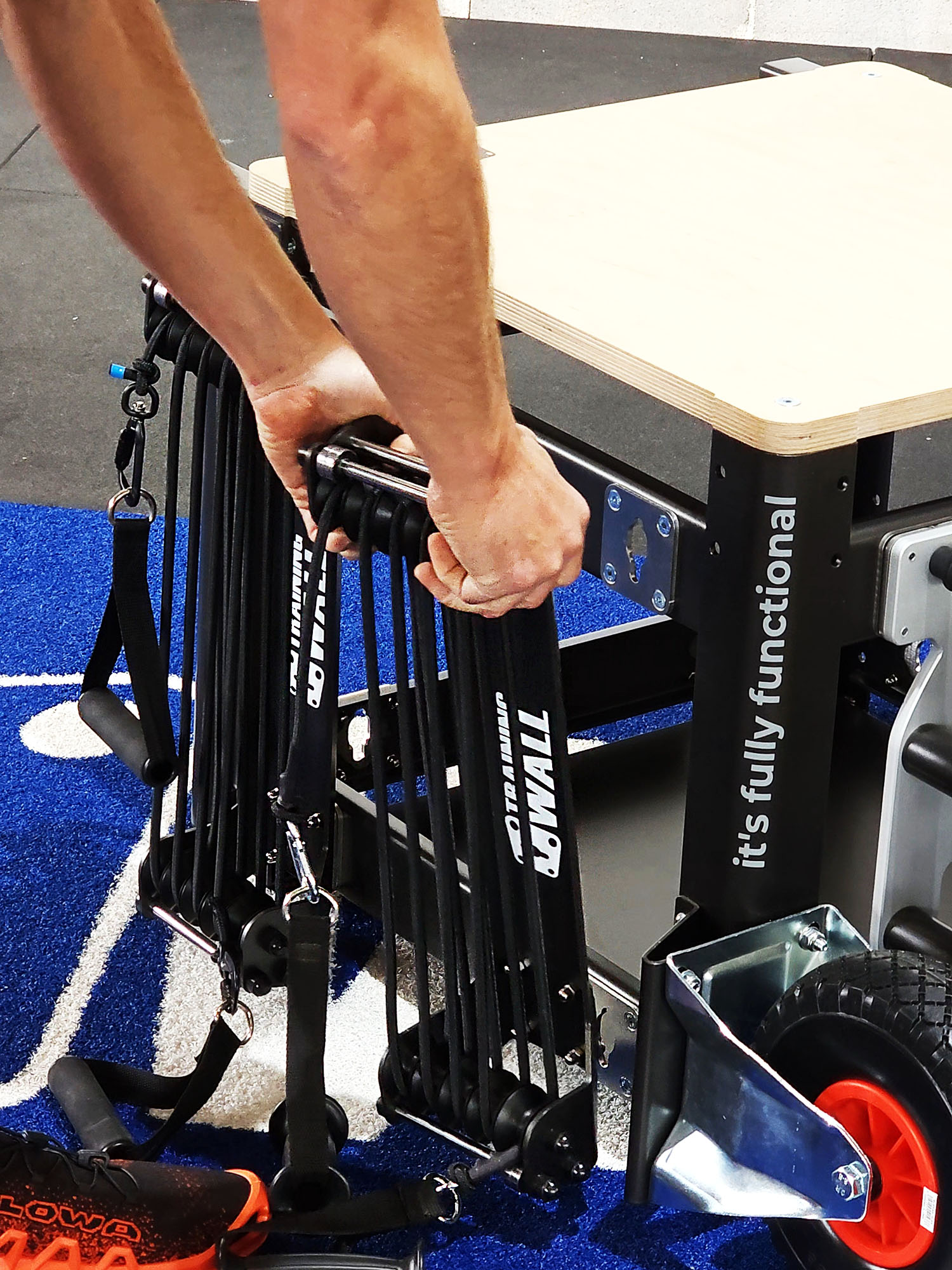
- TeamMate: provides a portable structure for compatible Training Wall accessories, making it easier to relocate the training station.
- SpinWall: introduces flywheel resistance, with loading generated through the acceleration and deceleration of a rotating mass.
The value of this combination lies in the range of training tasks it makes available. Coaches can organise complementary exercises around one station while selecting the resistance method that fits each task.
What does a flatter resistance curve mean?
With a conventional elastic band, tensile force generally increases as the band is stretched. The resistance experienced at the beginning of a movement can therefore differ substantially from that experienced near the end.
The Speed Tool is designed to flatten this resistance curve across its working range. In practical terms, this means limiting the increase in resistance as the athlete moves farther from the starting position. A flatter curve should not be interpreted as a perfectly constant force under every condition, or as an identical muscular demand throughout the exercise.
Joint angles, body position and the direction of pull still influence the task. Coaches should therefore consider both the resistance provided by the equipment and how that resistance acts on the athlete during the movement.
How SpinWall adds a different loading mechanism
Flywheel training works differently from elastic resistance. During the pulling phase, the athlete transfers energy to a rotating flywheel. As the cord rewinds, the athlete must absorb that energy and control the return. In suitable exercises, this creates successive concentric and eccentric muscular actions.
The training demand depends on the selected moment of inertia, the effort applied and the execution strategy. Eccentric overload should not be assumed simply because a flywheel is being used: the braking phase must be managed appropriately, and confirming overload requires measurement.
For portable setups, SpinWall Compact is the model included in Training Wall’s TeamMate inertial pack. Its adjustable inertia allows coaches to change the mechanical conditions of an exercise without treating the device as a conventional stack of weights.
Portability that supports session organisation
TeamMate allows compatible accessories to be transported and used across different training areas. This can help coaches organise sessions indoors or outdoors and position equipment close to the activity being coached.
Moving the station also changes the training environment. The available floor space, surface, pulling direction and stability of the complete setup should be checked before selecting the exercise and increasing its intensity.
Practical priorities for coaches
When introducing this combination, a useful starting point is to define the task before choosing the load:
- Choose the movement objective. Decide whether the exercise emphasises force production, movement speed or controlled braking.
- Set the direction of resistance. Position the athlete and attachment point so that the line of pull matches the intended task.
- Establish a controllable working range. Begin with a range that allows consistent positioning and a smooth return.
- Progress one variable at a time. Adjust resistance, speed, range or exercise complexity while observing how execution changes.
- Keep the two resistance methods distinct. Elastic tension and flywheel inertia require different loading decisions and coaching cues.
The original demonstration also introduces the option of combining two Speed Tools. This provides another configuration to explore, with the appropriate arrangement determined by the intended movement and the equipment’s setup instructions.
A modular system for more training options
Speed Tool, TeamMate and SpinWall offer complementary ways to organise resistance training. Their usefulness comes from matching the setup to a clear objective and adapting the task to the person performing it.
Explore Training Wall products or contact our team to discuss a configuration for your training space.