

13 Oct The C or the Arch: Mobility and Body Control with Training Wall
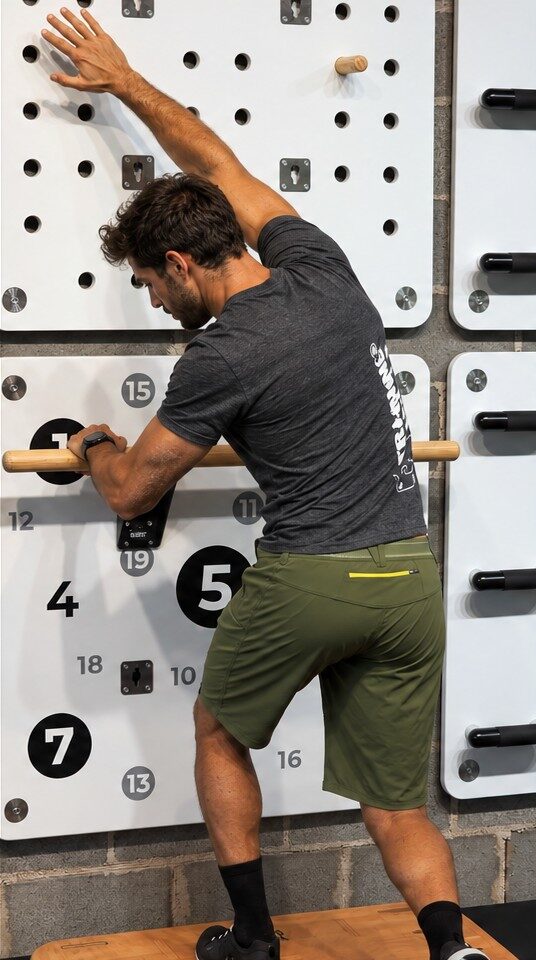
Reaching further with the hands or feet does not always mean performing an exercise better. In mobility training, the way a movement is achieved matters as much as its range. The C or the Arch exercise with Training Wall explores a greater reach while maintaining body control, connecting the movement of the limbs with the organisation of the trunk.
The exercise combines mobility, stability and coordination. The intention is to progressively reposition the hands and feet to create a broad arch through the body, without gaining that range by losing control of the shoulders, pelvis or spine. Its progression follows a clear principle: position first, then control, and finally range.
See the C or the Arch in action
Watch the original Training Wall demonstration on YouTube.
One connected movement, from hand to foot
The Arch directs attention beyond a single joint. The hand, shoulder, scapular girdle, trunk, pelvis and lower limbs contribute to the same task. Changing the position of one extremity requires the rest of the body to adjust while maintaining continuity through the movement.
This is the practical meaning of muscular-chain work in this exercise: observing how different body regions coordinate, rather than considering only how far one region moves. The cue “from palm to sole” expresses that whole-body intention; it does not mean that every muscle works in the same way or at the same intensity.
What to observe before increasing range
The demonstration description highlights several technical reference points. Coaches can use them as observation criteria adapted to the individual and the stage of the movement, without turning the exercise into a rigid posture.
- Shoulders: watch for excessive forward positioning used to gain reach at the expense of the intended starting organisation.
- Scapulae: allow controlled movement without unnecessary shoulder shrugging. Scapular control does not mean holding the shoulder blades still.
- Pelvis: avoid gaining apparent range through additional anterior pelvic tilt that substitutes for the intended movement.
- Spine: observe its curves and the relationship between the rib cage and pelvis, rather than pursuing range through changes that move away from the exercise objective.
For example, reaching a more distant support while noticeably changing pelvic position and losing control of the return does not, by itself, demonstrate progress. A slightly smaller range that remains controlled and repeatable provides a more useful starting point for further development.
Elongation: creating length through the movement
Elongation is a central coaching cue in the Arch. The intention is to create a sense of length and reach while maintaining the relationship between the shoulders and pelvis as the extremities move further apart. The task is more specific than simply arching the back further.
In this context, “growing” through the movement is an instruction that guides execution. It does not demonstrate separation of the vertebrae or a structural change in the tissues. Its practical value is to encourage the participant to distribute the movement instead of concentrating the entire search for range in one area.
Build the progression in four stages
- Establish the starting position. Choose supports that allow the shoulders, trunk and pelvis to be organised before attempting a longer reach.
- Explore a small range. Reposition the hands and feet gradually, observing how the body responds as a whole.
- Control both the outward movement and the return. Check that the participant can come back without rushing or losing the reference points established at the start.
- Increase one variable at a time. Extend the reach progressively while preserving the quality demonstrated in the previous range.
To compare sessions, coaches can record the supports used, the reach achieved and the corrections required. Progress can then be assessed through consistency and a reduced need for prompts, rather than relying only on how large the movement looks.
Bring mobility and control into the session
The Arch can be introduced as a movement-learning task within a mobility and body-control block. A coach can focus on one reference point at a time before checking whether it is maintained when the complete movement is brought together. There is no need to pursue maximum reach on every attempt.
Training Wall provides an environment for exploring this relationship between support positions, reach and coordination. The aim is to develop a range that the participant can control, reproduce and adapt to the purpose of the session.
Plan your space with the Training Wall configurator or contact our team to explore the system for your studio or training centre.
Reference: the original C or Arch demonstration and description published by Training Wall. The progression sequence and coaching examples expand on the criteria presented in that publication.