

01 Oct How to combine inertial and elastic resistance in the Training Wall ecosystem
A training system becomes more useful when its tools have clear and complementary roles. SpinWall, SpinWall Plate, Load Plates and Speed Trainer allow a coach to organise inertial work, platform-based exercises and elastic movement tasks around one equipment concept. Understanding the differences between these resources makes it easier to decide what to use, when to change it and how to progress the session.
Four components within one organised setup
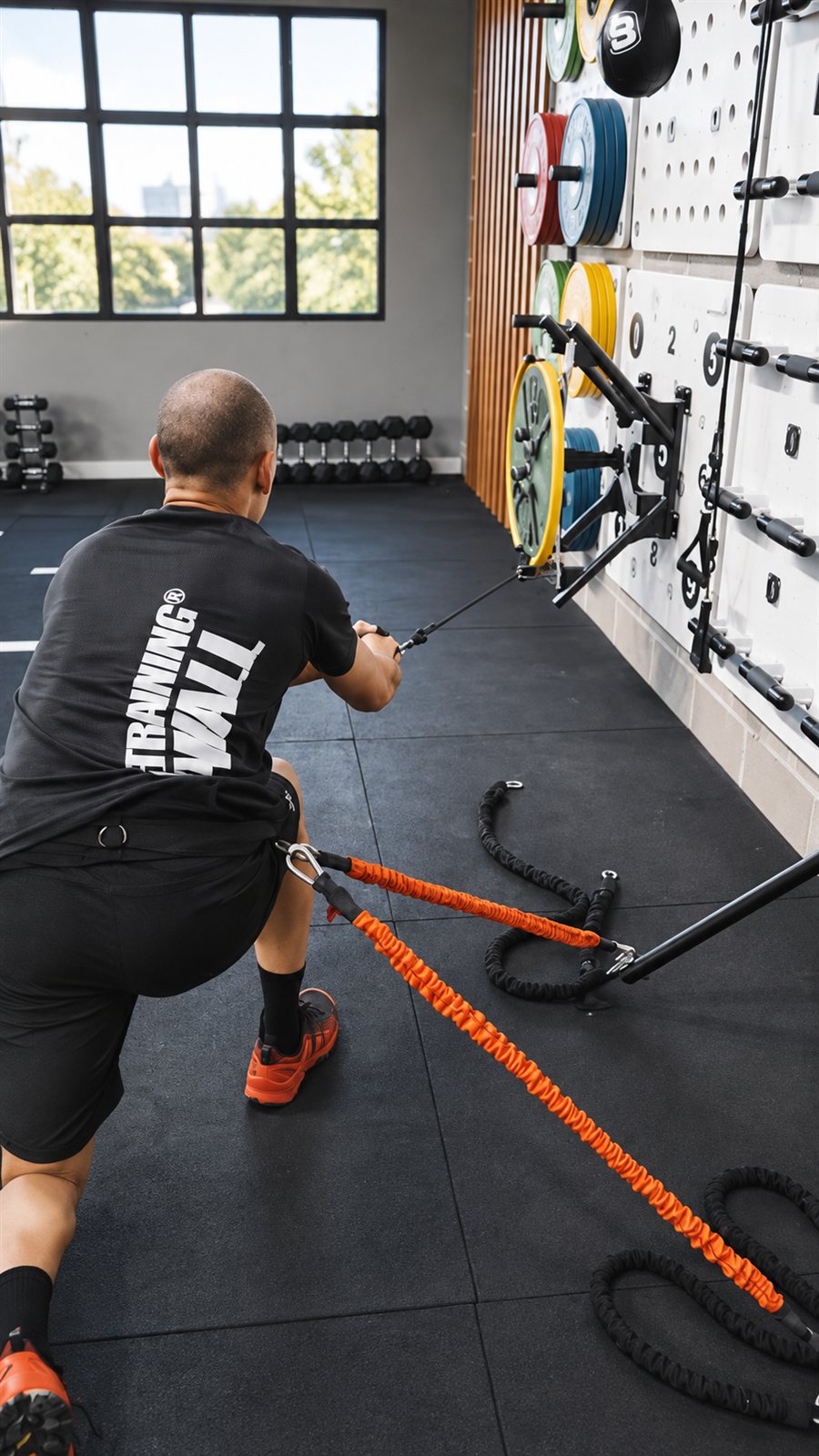
Adjusting SpinWall weights changes the inertial setting. The Plate creates a position for lower-body patterns, while Load Plates help stabilise that setup. Speed Trainers attached to the Load Plates introduce elastic resistance, with a different response through the range of movement.
The flywheel stores energy as it is accelerated and returns that energy as the cord rewinds. The user has to manage the return rather than simply release the handle. Elastic equipment stores energy through deformation and has its own force-extension behaviour. These mechanisms can serve related training objectives, but the cues used to explain and control them should be different.
Selecting resistance by the task, not by habit
The coach can sequence these elements according to the objective: controlled strength, acceleration, braking or coordinated movement. The useful progression is the one the athlete can perform consistently. Check the connection of every component and leave enough working space before adding speed or complexity.
There is no need to combine all the tools in every repetition. A strength block can be followed by a separate movement task, with time to adjust the station and explain the next demand. This approach also makes it easier to observe whether fatigue from the first block is changing the quality of the second. The equipment supports the programme rather than dictating it.
Give each resistance block its own instructions
Moving from an inertial task to an elastic task requires more than selecting another tool. The participant needs to understand how to initiate the movement, manage the return and finish the repetition with the equipment in use. Use a short rehearsal when changing resistance types. Familiarity with one exercise does not establish familiarity with the next, even when the movement looks similar or takes place within the same station.
A session might use one block to practise a controlled pulling pattern and another to explore a related movement with a different direction of resistance. Describe what should remain consistent and what deliberately changes. Compare execution within each task rather than treating the settings of different devices as interchangeable measures of effort. Record the tool, setup and participant response separately. This helps the coach decide whether the combination adds a useful learning demand or simply increases the number of equipment changes without improving the session’s clarity.
An example of how to structure the session
- Begin with a familiarisation block, focusing on the range and return of the selected resistance.
- Develop the main strength task with a repeatable position and an effort suited to the participant.
- Change the setup for a complementary elastic task, making the direction of pull explicit.
- Review execution and recovery before adding another exercise or increasing the demand.
A modular ecosystem offers choices; a good session gives those choices an order. Matching the resistance method to the intended task is what makes the combination useful for professional coaching.
Plan your training space with the Training Wall configurator or contact our team to discuss a configuration suited to your needs.
Sources and resources
The organisation examples and practical stages are editorial suggestions for this article. Adapt them to the objective, the participant and the equipment instructions.