

01 Oct Stability Board: programming balance and controlled instability
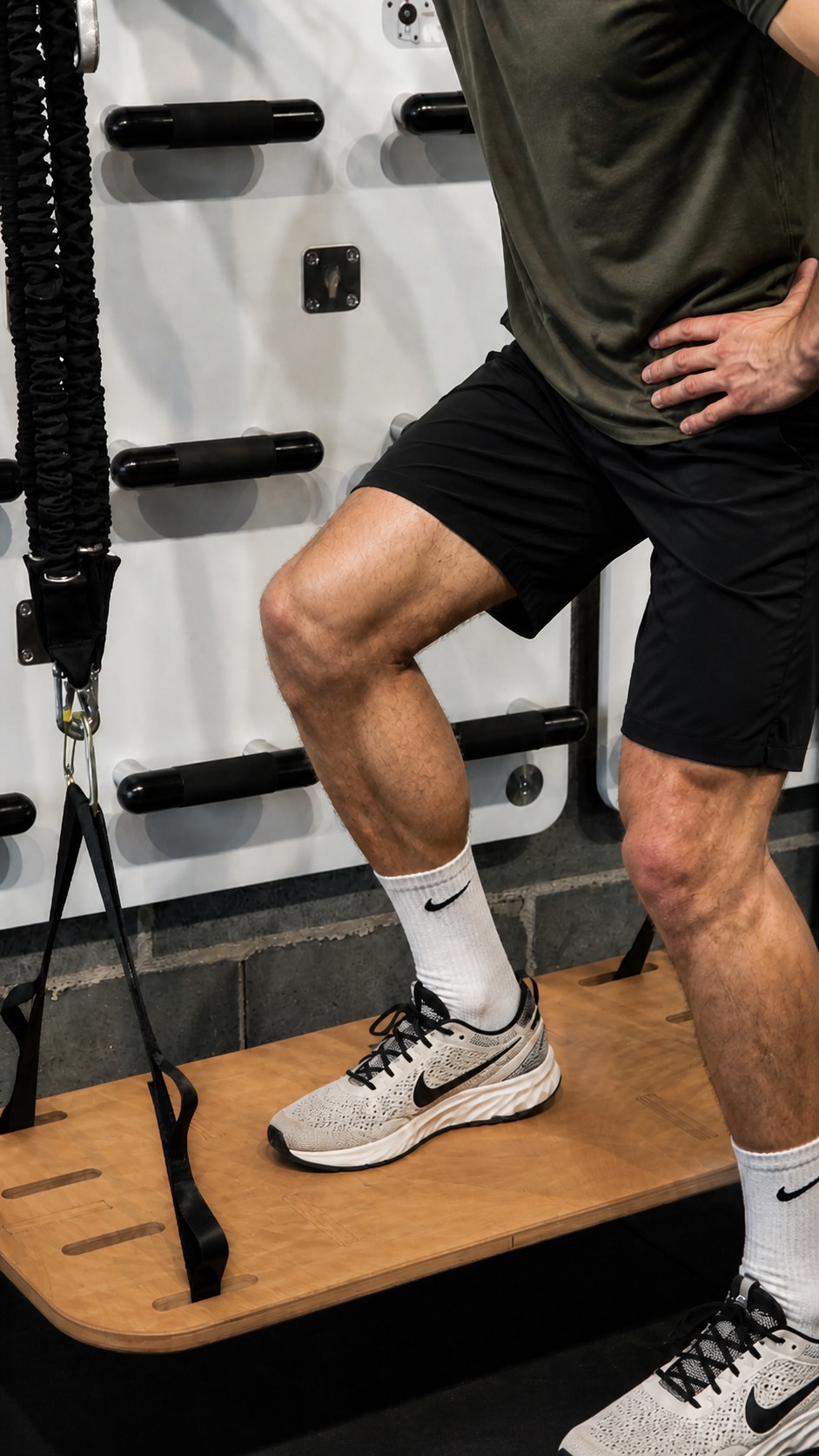
Balance training becomes more useful when its difficulty can be adjusted with a clear purpose. Stability Board adds a platform for weight shifts, controlled changes of support and coordinated movement within the Training Wall ecosystem. It can be used on the floor or in compatible arrangements with Low Gravity, straps or elastic bands, allowing the professional to select the kind of instability that fits the task.
What changes when the support surface moves
Instability changes the control demands of a task. It may be useful for balance, awareness of body position and carefully graded coordination work, but it is not automatically an improvement over a stable surface. Start with the task objective and the person’s ability to maintain a controlled position.
A moving base asks the user to manage the relationship between the feet, lower limbs and trunk as the support changes. The task can remain simple: holding a chosen position, shifting weight deliberately or returning to the centre. The professional should be able to identify what the person is controlling before making the surface or the exercise more demanding.
Combining the board with support and resistance
Low Gravity may provide support while the coach adjusts the challenge; elastics add a further force to manage. Introduce one change at a time, use a suitable surface and supervise transitions on and off the board. The progression should remain observable and repeatable.
The attachment arrangement is a genuine training variable. The product allows changes in strap spacing and the use of fixed straps or elastic bands to modify the response. Those changes should be introduced intentionally, because they can alter the direction and predictability of movement. A supported task and a suspended or elastic setup should not be treated as equivalent versions.
Choose a balance task you can describe and repeat
A clear balance task might ask the participant to shift weight towards one side and return to a recognisable centre position. The professional can observe how the movement starts, whether the person uses the available support and how the return is organised. This provides more information than simply timing how long someone remains on the board. The observation should relate to the task being taught, rather than assuming every visible movement of the platform is a mistake.
If reaching is added, define the target and keep it within a manageable range. Compare the response with the previous version before changing the support arrangement as well. Combining several changes makes it difficult to identify which one altered performance. In a shared session, allow time for each participant to get on, establish their position and get off deliberately. The practical aim is a repeatable challenge with an understandable progression, not a competition to create the greatest possible instability or remove support as quickly as possible.
Progressing balance work in observable stages
- Establish a controlled starting position and a clear way to get on and off the platform.
- Introduce a deliberate weight shift or a small movement that can be repeated consistently.
- Change one condition, such as support or attachment arrangement, while keeping the task understandable.
- Integrate reaching or resistance only when it serves the objective and the user can manage the added demand.
Stability Board gives trainers and clinicians another way to organise balance tasks. Its value lies in the ability to choose and adjust the challenge, rather than in making every exercise as unstable as possible.
Plan your training space with the Training Wall configurator or contact our team to discuss a configuration suited to your needs.
Sources and resources
The organisation examples and practical stages are editorial suggestions for this article. Adapt them to the objective, the participant and the equipment instructions.