


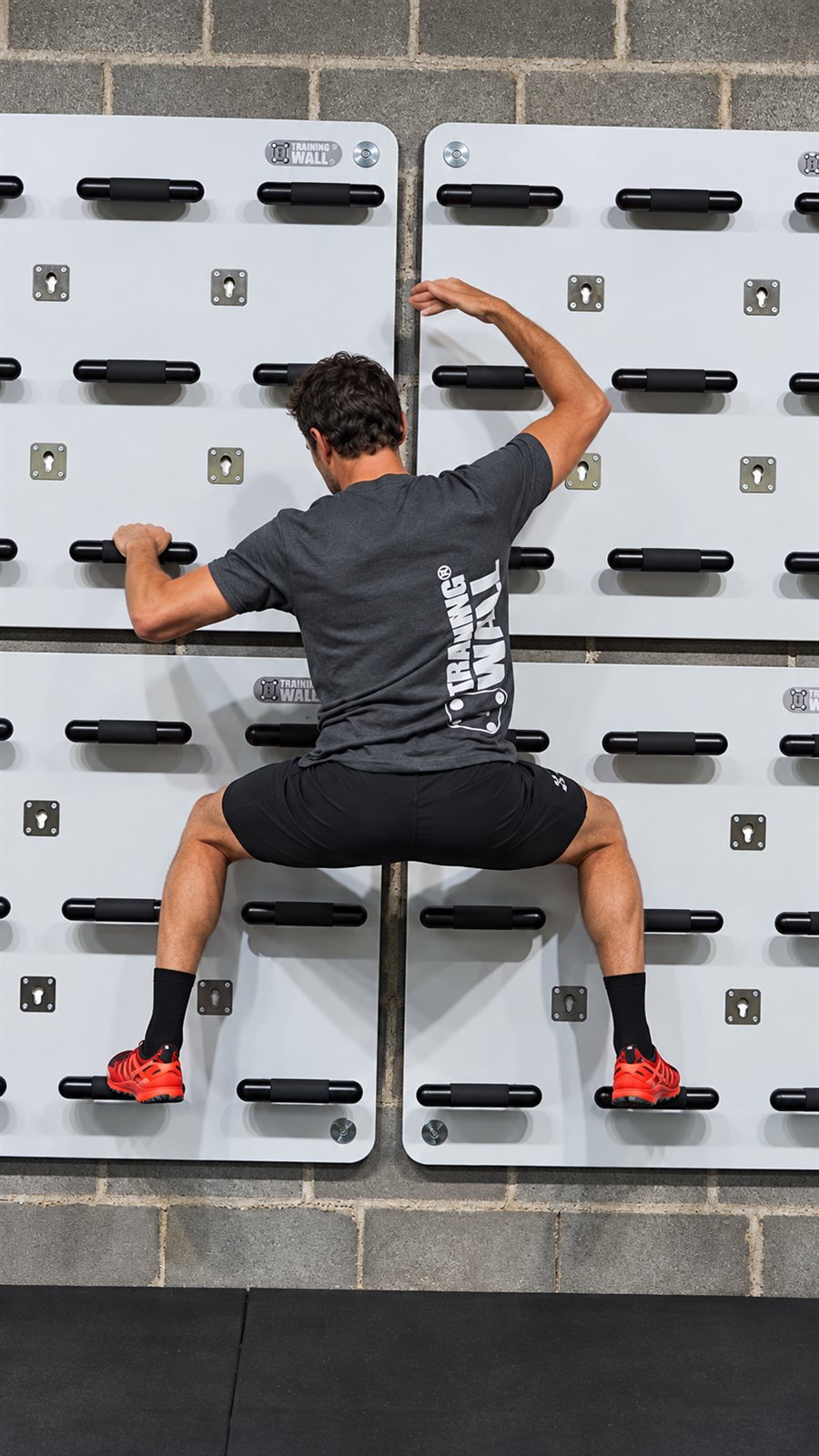
01 Oct Trunk tilting: coordinating lumbar movement and whole-body stability
Trunk tilting is an opportunity to explore how the trunk moves in relation to the rest of the body. The exercise brings lumbar movement into a task that also involves support through the lower limbs and contact through the upper body. Within Training Wall, the professional can use those relationships to teach a deliberate movement and observe how the person manages the return.
Mobility and stability within the same movement
During a tilt, the coach can observe how the person distributes movement, manages the support points and returns to the starting position. Range is not the only measure of quality. A smaller, repeatable movement may be more appropriate than forcing a larger arc that changes the intended pattern.
The objective is not to keep every body segment still or to seek the largest possible tilt. It is to identify where the movement is intended to occur and how the rest of the body contributes. The distribution of movement can differ between users. A clear starting position gives the professional a reference for observing those differences across repetitions.
Using support to make the task understandable
Adjust support, tempo and resistance to the person’s ability and objective. For pain or rehabilitation, the exercise belongs within an individual assessment and progression. The selected version should reflect that assessment.
Contact with the panel can provide a reference while the user practises the movement. The amount and type of support should match the task, rather than being changed simply to make it harder. A slow, deliberate rehearsal helps establish the path and the return before the coach considers another range or resistance. The person’s response determines whether that change is useful.
Teach the return as carefully as the tilt
The outward movement and the return can present different learning demands. Explain both before asking for a larger range. A clear reference for the starting position helps the participant recognise when the repetition is complete, while a deliberate return gives the professional another opportunity to observe coordination. There is no need to prescribe a universal tilt angle: the useful range is the one that fits the individual task and can be explored with appropriate control.
One teaching option is to practise a small excursion, return to the reference position and discuss what the participant noticed. Repeat the same task before altering the support or range. This makes it easier to distinguish growing familiarity from a genuine change in difficulty. In a clinical context, decisions must remain connected to the professional assessment and the person’s response. The demonstration should not be read as a treatment for a particular condition or as evidence that a larger lumbar movement is always the desired outcome.
Teaching trunk tilting step by step
- Establish the intended support points and explain the direction of the tilt.
- Explore a manageable range, keeping the start and finish easy to recognise.
- Practise a controlled return and compare successive repetitions before increasing the range.
- Adjust the task to the individual objective; in clinical use, follow the professional assessment and response to exercise.
Trunk tilting connects mobility with an observable movement task. Training Wall supplies contact and configuration options; careful instruction helps the user understand how to move and return with control.
Plan your training space with the Training Wall configurator or contact our team to discuss a configuration suited to your needs.
Sources and resources
The organisation examples and practical stages are editorial suggestions for this article. Adapt them to the objective, the participant and the equipment instructions.